
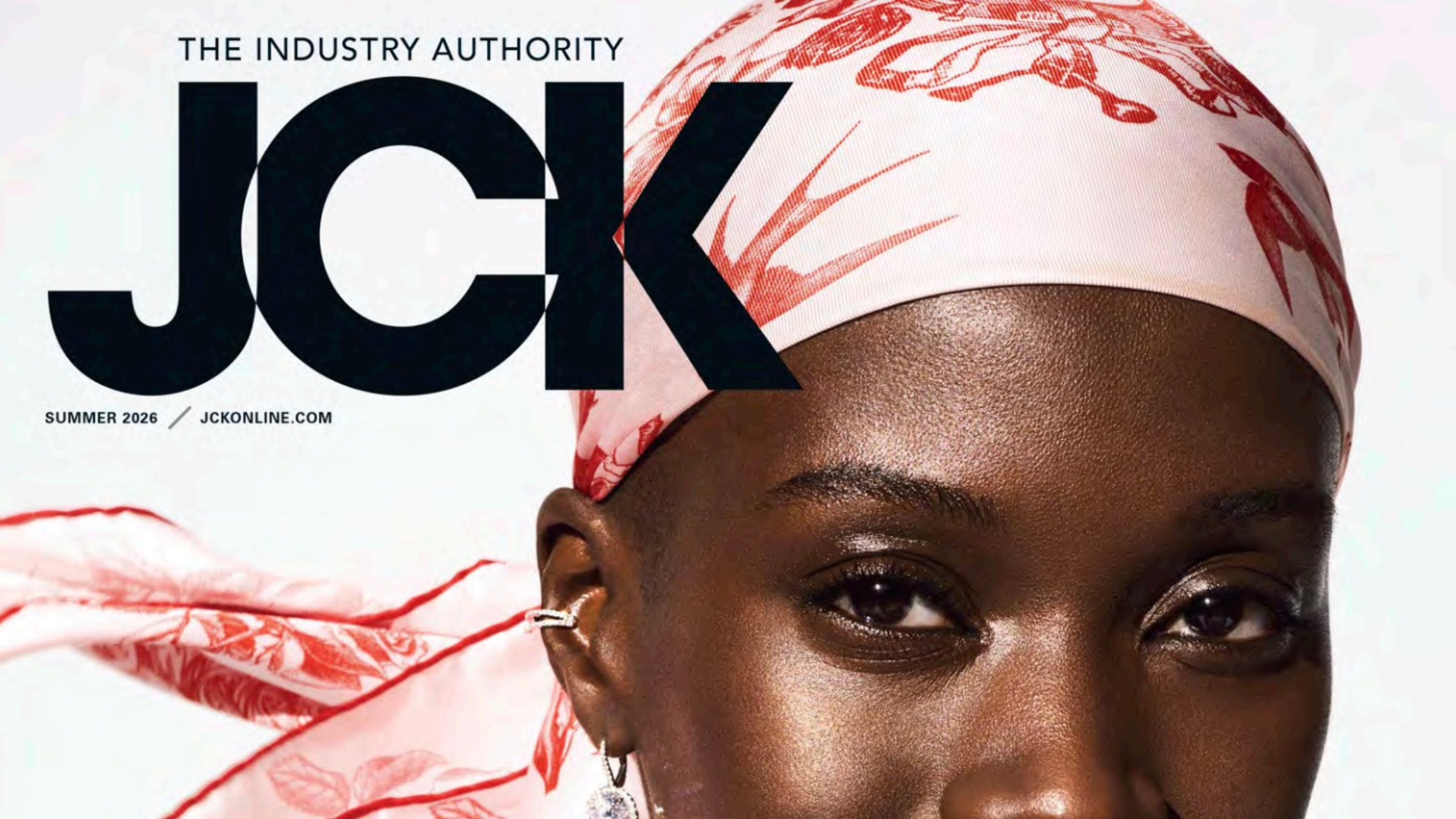
Ray of Color: Ray Griffiths Featured in JCK Magazine's Summer 2026 Designer Showcase
Ray Griffiths was featured in JCK Magazine's Summer 2026 Designer Showcase in a profile by Rima Suqi titled "Ray of Color." The full article is reproduced below with permission. Read the original at JCKonline.com.

From Melbourne Apprentice to New York Mainstay
From Melbourne apprentice to New York City mainstay, Ray Griffiths keeps evolving as does his love of gemstones.
"When I started my career, I wanted all gemstones to be perfect," Ray Griffiths tells JCK.
The 69-year-old designer is perched in an Eames lounge chair in his New York City apartment. Just back from the Tucson gem shows, he's excited, scrolling through photos of his (substantial) finds.
Embracing Nature Over Perfection
"The older I get, the more I want to see nature, and the more I want to see natural," he says.
Inclusions, once dismissed as flaws, are now objects of fascination "because they're more interesting." Griffiths reaches for a piece of Lithuanian amber to make his point.
"Look at what's inside it! Lily pads! If that was perfect, you'd think it was a piece of plastic. But it's the lily pads that identify it and give it a sense of reality. It's beyond beautiful."
This marks a subtle shift for Griffiths, a bench trained jeweler long associated with richly saturated gemstones and intricately carved 18k gold. After decades in the industry, the Australian native's appetite for visible signs of nature is what drives him now and his yearly buying trips to Tucson still ignite the kid in a candy store thrill.
A Compulsion for Color
"I'm relatively compulsive while I'm in Tucson because I'm buying what I love, and I'm buying color," he admits.
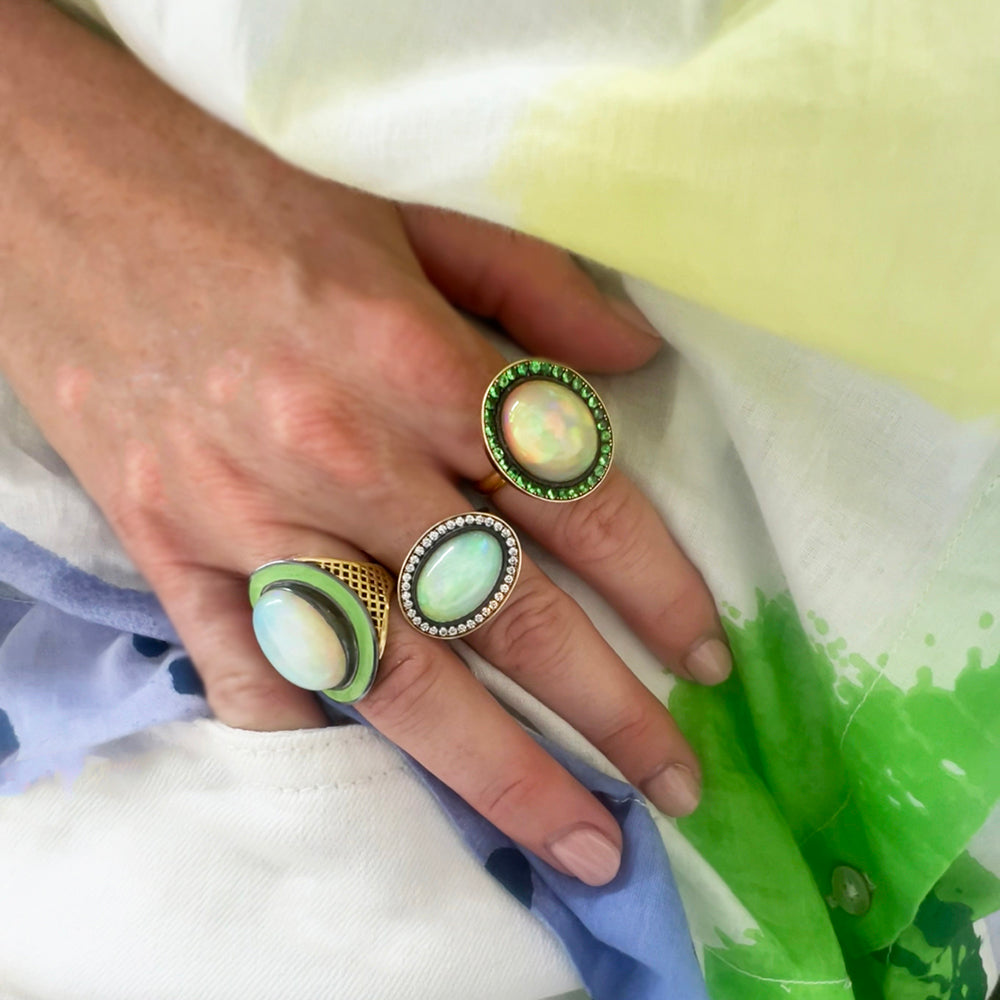
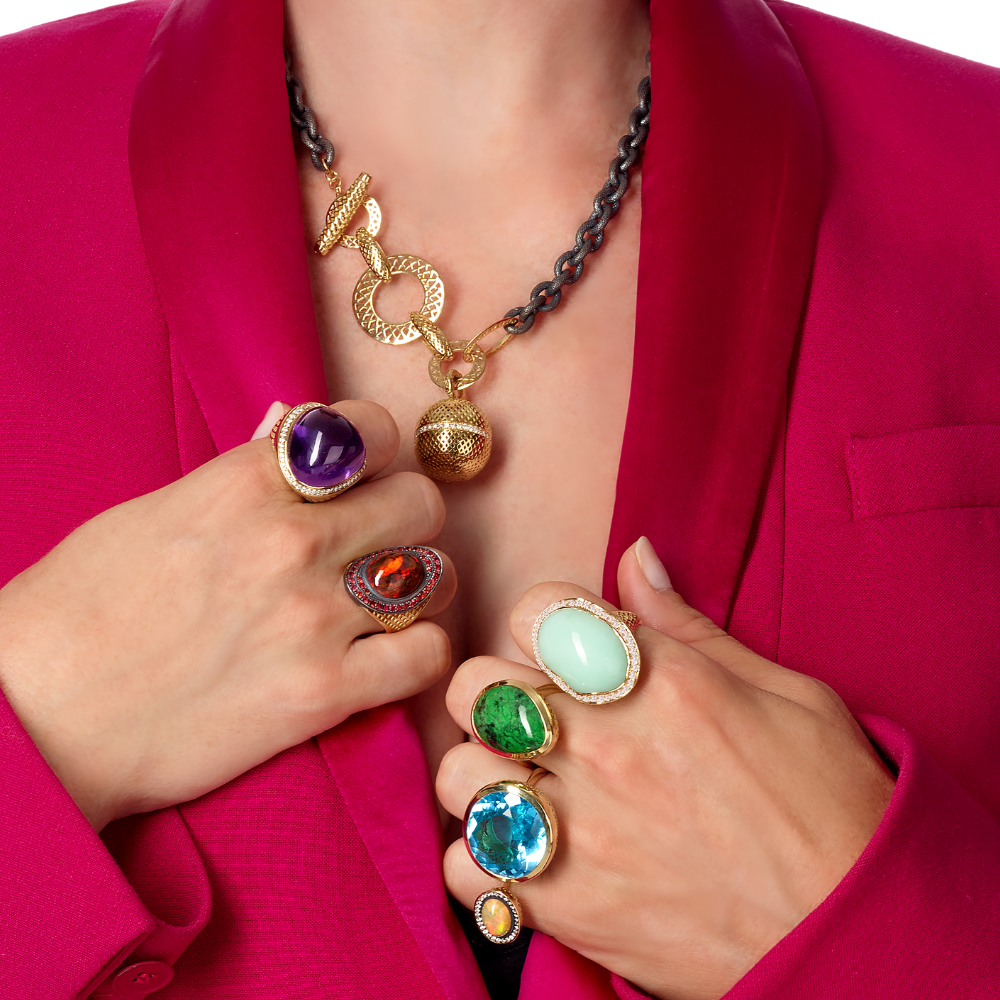
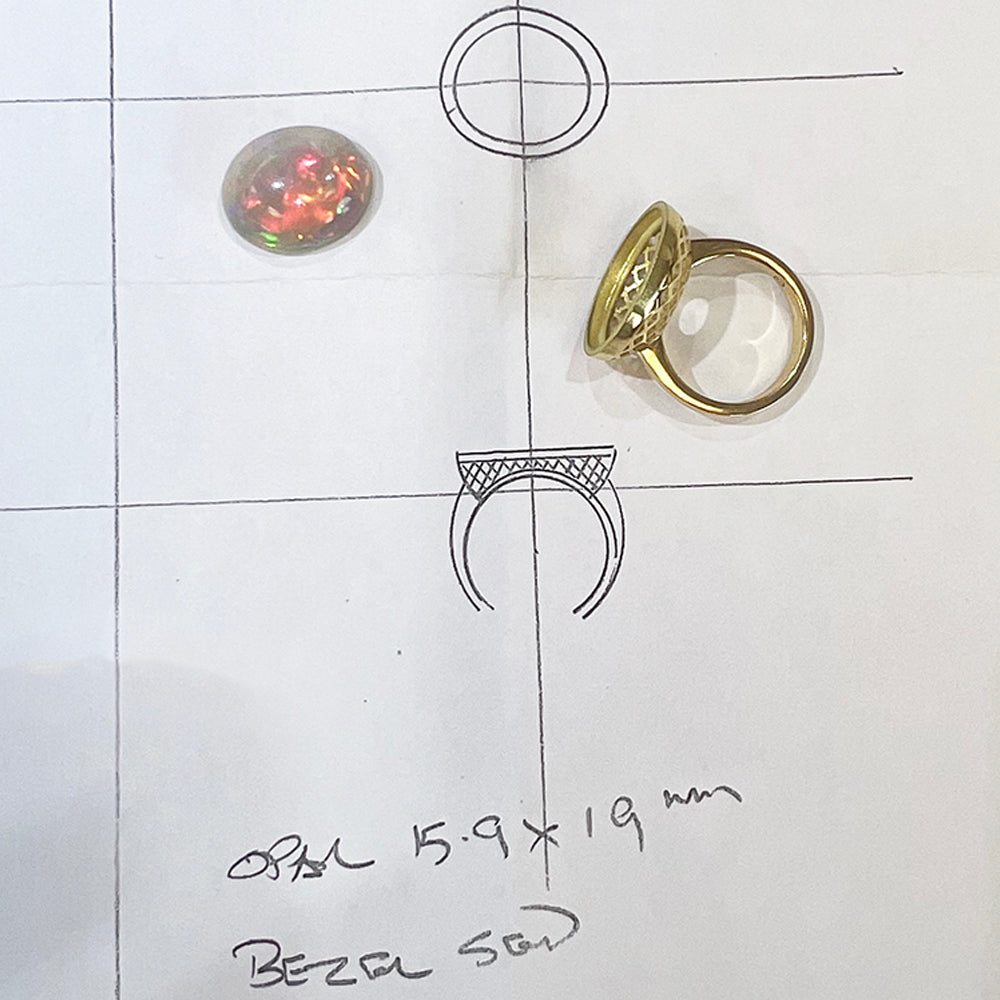
This year's haul included Australian chrysoprase threaded with dendrites, Mexican fire opals, lavender jade, variegated carnelian, chalcedony, and golden Australian South Sea pearls, all chosen for personality versus perfection.
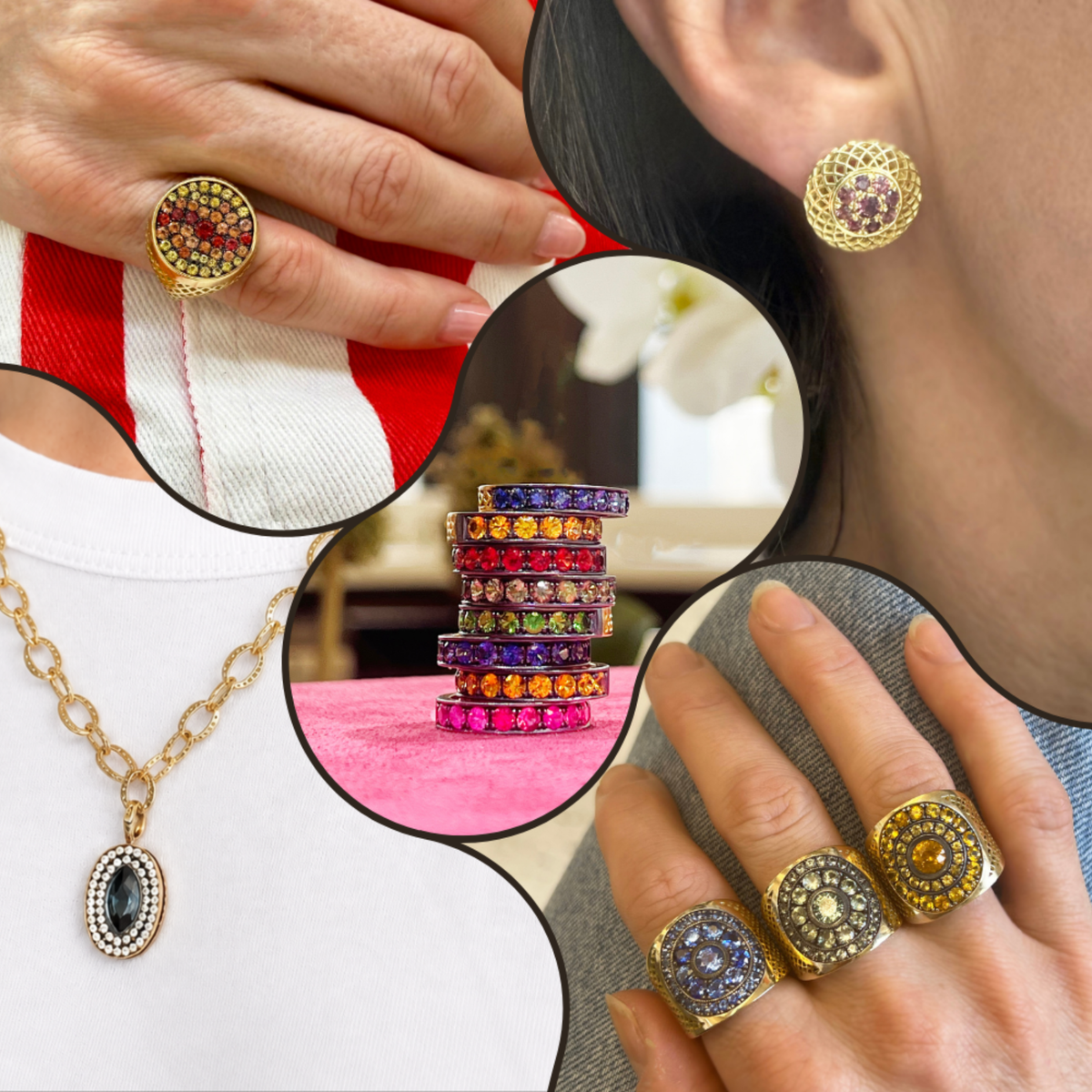
"Years ago, someone said to me I'd never make money in the jewelry business because I do color and everybody else is selling diamonds, but color is what I love," he says.
By staying true to that instinct, eschewing trends, and remaining consistent in his design language, Griffiths has built a loyal following and a successful business.

The Crownwork® Signature
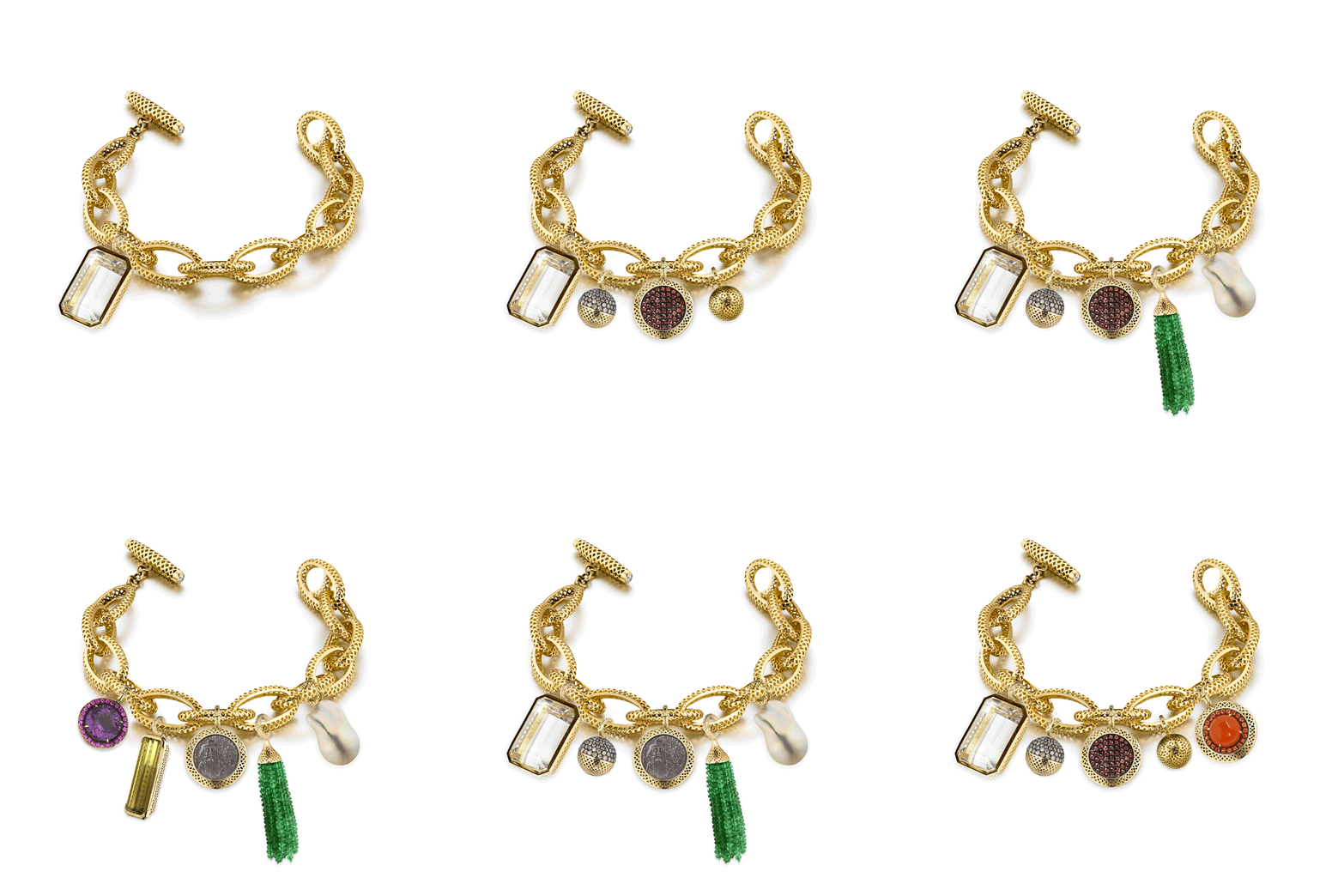
He is also one of the few in the field with trademark protection, granted 25 years ago for Crownwork®, the gold grid pattern that has become his signature.
"I came to understand that I needed to find my concept, the thing that would separate me from the other designers," Griffiths says. "Something that was personal to me, that would be technically excellent and I would be proud of."
The technique removes metal strategically, allowing Griffiths to create bold, sculptural pieces that are deceptively lightweight no small consideration in an era of soaring gold prices.
Its versatility became apparent the more he experimented with it. "I thought, 'Oh, I can apply this to any shape, any structure, anything in the jewelry world.' And because I could apply it to anything I wanted to, I wasn't stuck in a genre."
Early Years: A Jeweler from Age Seven
Griffiths' forward thinking mindset, combined with a large dose of tenacity, was ingrained early on.
"From the time I was 7, I would say to my parents, 'When I grow up, I want to be a jeweler,'" he says.
It was an unexpected declaration for a boy from Melbourne raised in a family of modest means. Griffiths was one of four boys born to a father who made and repaired shoes and a mother who worked at an off track betting establishment.
"We were told, 'If you want money, you go find a job and earn it,'" he recalls. At 12, he did exactly that, making 25 cents an hour working in a neighbor's garden.
Apprenticeship at Dunklings in Melbourne
In 1971, Griffiths' father arranged for his son, then 15 years old and admittedly not thriving in school to become an apprentice at Dunklings in Melbourne, then among Australia's most posh and respected jewelers.
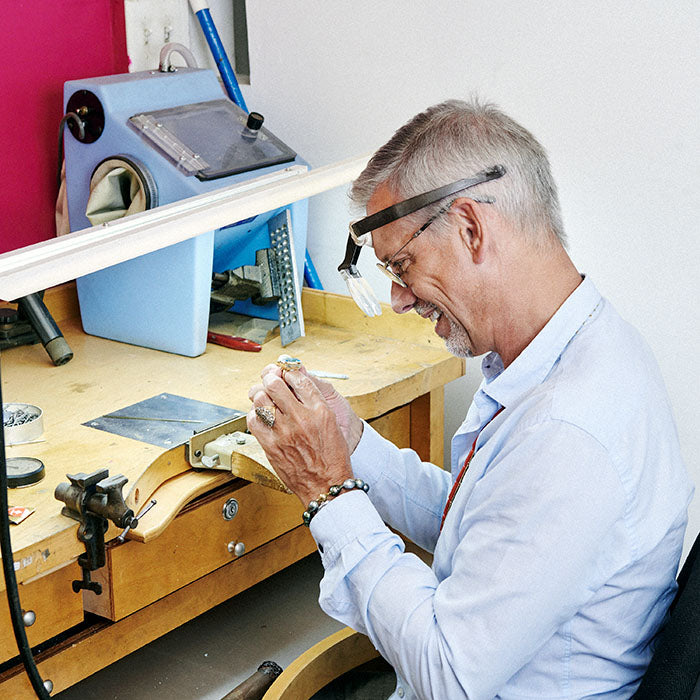
The three-month trial period was exacting. "It was old school; you had to make everything by hand, like cutting silver plate and soldering chain," Griffiths says.
He was the youngest in the workroom and the only left handed apprentice. "They looked at me and probably thought, Oh, he'll be hopeless," he recalls. "But everything that they gave me to produce, I did perfectly. I was really good and really accurate."
At 16, he left school and joined Dunklings full time. While there, he encountered an early version of the Crownwork® technique he would later refine and make his own. He also created his first custom design: a pair of diamond earrings for his mother's birthday.

Design as Construction and Architecture
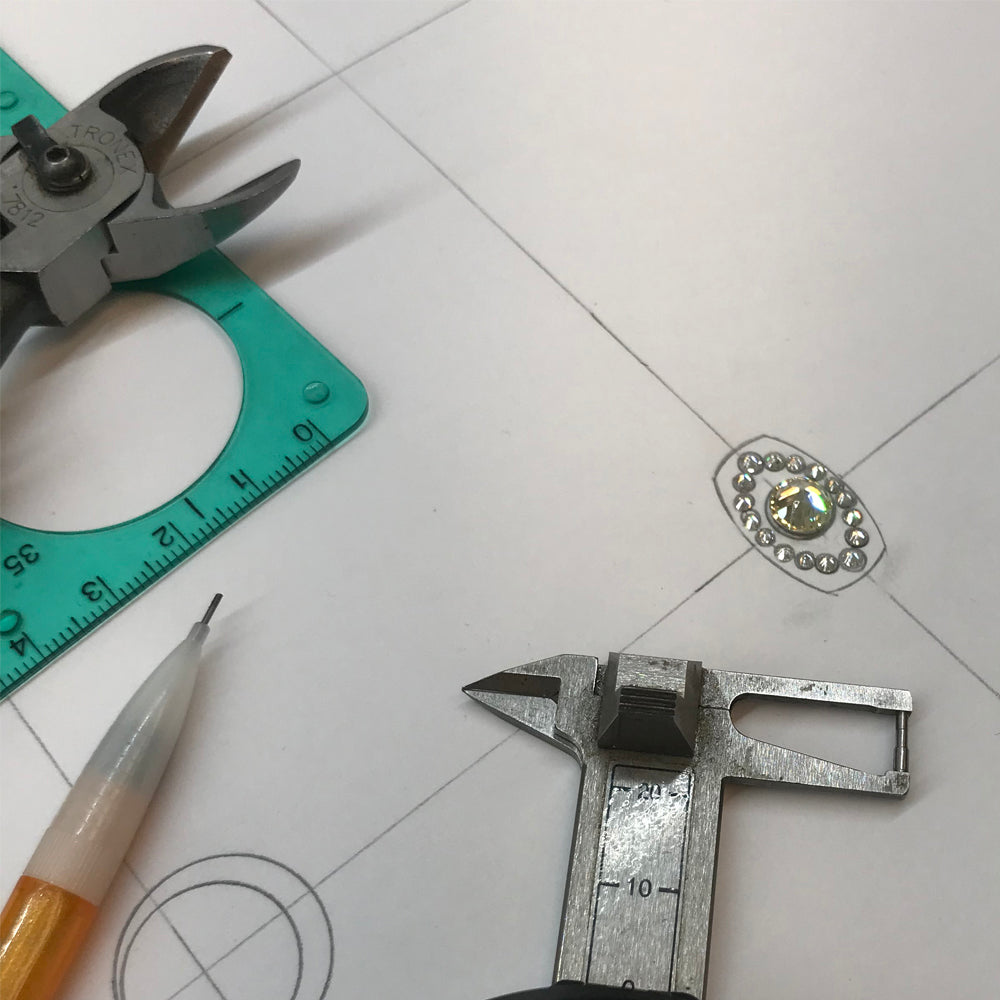
The years at the bench shaped how Griffiths would later approach design: as construction and architecture, with serious consideration given to ergonomics.
Even when he temporarily stepped away from jewelry, first into fashion retail in Melbourne, followed by two years in London in the early 1980s, he was absorbing everything he could about taste, presentation, and selling.
Back in Australia, he joined Rox in Sydney and, over nearly two decades, helped transform the jewelry boutique in the city's Strand Arcade into a national destination.
"We became the most sophisticated jewelry store in the country," Griffiths recalls. "We had the most interesting designers; we made the most beautiful things and created avant garde ads that ran in Vogue."
The experience sharpened his eye and broadened his ambition.
A Pursuit of Mastery
Despite the success, Griffiths was restless.
"I thought, If I'm going to be a jeweler for the rest of my life, I want to be the best I could possibly be. I'd done a lot, but I wasn't properly educated, and that stuck in my craw."
While still working at Rox, he enrolled in evening courses in Sydney and ultimately earned degrees in both gemology and the atomic structure of diamonds.
A New Life in New York City
In the mid 1990s, he won a U.S. green card lottery and chose to move to New York City over England or France.
"I was fascinated by the art and design in America, and especially the jewelers," Griffiths says. "I thought they were more modern and interesting."
He was in his early 40s, and starting over was hardly seamless. The shipping container carrying his tools and belongings vanished en route.
Griffiths found an apartment in Tribeca, shared a studio in the Meatpacking District, and made jewelry at night while working days as a salesperson at Fragments in SoHo then one of the city's hottest jewelry boutiques.
In a clever move, he consigned his own pieces to the store, earning commission both as salesperson and designer. He quickly became not only the top salesperson but also a top vendor. After nine years, at 50 years old, he left to focus exclusively on his own line.
A Jeweler's Jeweler
Two decades later, Griffiths shows little interest in slowing down.
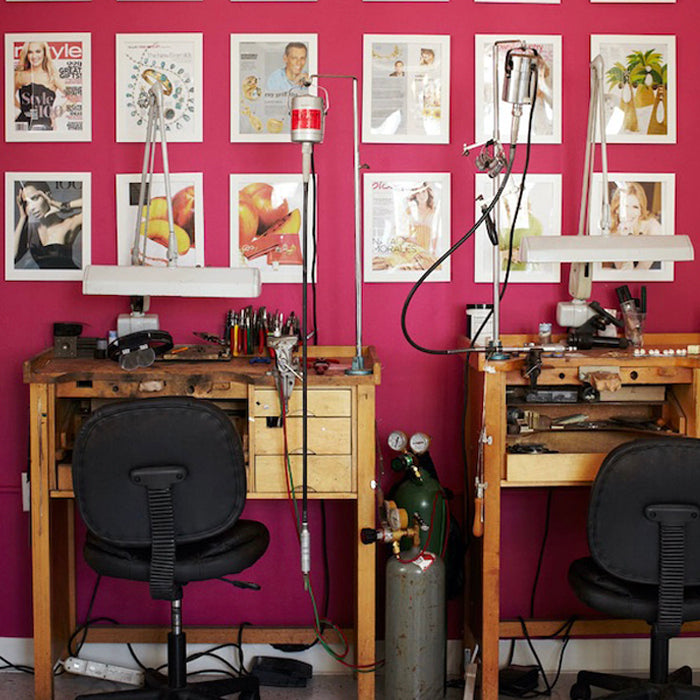
He walks most mornings from his Lower East Side apartment to his Fifth Avenue atelier, boasting enviable views of the Empire State Building. He works with two full time employees who have been with him nearly from the start, and maintains an ambitious trunk show schedule that has earned him million miler status on United Airlines.
Among peers, Griffiths is often described as "a jeweler's jeweler."
Staying Relevant: The Larger Crownwork® Collection
Complacency is not in his vocabulary.
"You have to remain relevant, and you have to look at what's selling in the market," Griffiths insists.
To that end, he recently introduced larger gold Crownwork® pieces hoop earrings, bangles, domed rings, cigar bands, and link chains. The collection was a major stylistic shift for him and a financial gamble, but resonated with his collectors and "sold like hotcakes," he says.
Gaudí, Barcelona, and Marquise Stones
Recent travels have apparently sparked yet another evolution.
A visit to Barcelona left Griffiths pondering line and movement as seen in the architecture of Antoni Gaudí. He returned to his atelier with hundreds of photos and stacks of drawings, keen on exploring different forms.
"I haven't touched marquise in years, and all of a sudden I was looking at marquise-shape stones. This fits into the Barcelona inside my head."
A Legacy of Happy Jewels
Two years ago, Griffiths published a monograph (written by Rima Suqi). Titled Ray Griffiths: The Works, it's a biography told in photos that document his designs over the years, including custom commissions. Assembling the book, now in its second printing naturally led to thoughts of legacy.
"I want to be remembered for fine quality jewelry that makes people happy. I've never lost interest in making jewelry. It's a passion that I was born with that's just never gone away."
Article by Rima Suqi for JCK Magazine, Summer 2026 Designer Showcase. Reproduced with permission.

